
The story that follows is a blow by blow account of my first trip to Mt Kilimanjaro, in fact my first climb on any mountain.
So why climb to the highest point in Africa when you’ve not done this before?
I guess “a little knowledge makes one dangerous” would not apply here. I simply had no knowledge of what it takes to climb above 3000 metres, so I decided why not do it. Everybody else seems to be able to do it.
Once the thought of summiting Mt Kilimanjaro set in, the sexiness of telling everybody that I am “climbing” Kili was like a drug. I got caught up in the euphoria and all the well wishers who patted me on my back saying that I am so brave and tough to take on such a challenge, furthered my resolve to do it.
The next question was …..
Would I go it alone?
As these things go, as you talk about a potential trek to Kilimanjaro, everyone seems either to have thought about it or it is firmly on their bucket list. So I threw out an open invite to anyone who would want to join to connect with me; 2 did.
Chandra and Chantal worked with me at some point in our lives at the “Bank” and they were keen but apprehensive about taking on an arduous task with zero preparation. My view to C&C was that if we do not book a date, we’ll procrastinate about our readiness to do it, so lets go ahead and commit to a date. It was up to me to contact the tour company and set a date; bad move on the part of C&C, as it was June 2011 and I set a date for September 2011.
After some convincing, we settled for a January 27, 2012 summit attempt, which meant the following itinerary:
Friday 20 Jan 2012 Depart Johannesburg
Saturday 21 Jan 2012 Arrive in Kilimanjaro Airport (via Dar-es-Salaam) and transfer to hotel
Sunday 22 Jan 2012 Start our 5 day hike to the Barafu High Camp
Thursday 26 Jan 2012 Start our summit attempt to Uhuru Peak
Friday 27 Jan 2012 Descend to Camp 1
Saturday 28 Jan 2012 Descend to Mweka Gate and return to hotel
Sunday 29 Jan 2012 Return to South Africa
Preparations
Having searched for tips and suggestions to train for a hike up a mountain, I came across many articles, training plans and nutrition suggestions. We followed these quite closely but I don’t think we were nearly as prepared as we should be for such an attempt. Chandra was the only one amongst us that had any regular training in him. As a runner, he was fitter than Chantal and me and more ready for this challenge.
If I am honest, I spent more quality time shopping for the latest clothing, gadgets and gear than training; but time elapsed and it was soon time when this got real.
Getting to Mt Kilimanjaro
We’ve been booked on a Precision Air flight from Or Tambo to Kilimanjaro Airport with a stop-over in Dar-es-Salaam on Friday January 20, 2012. On January 19, a huge tropical storm came in over the Mozambican Channel which grounded all flights over this flight path. The Precision Air flight from Tanzania did not depart Dar-es-Salaam, hence we had no flight to catch. To our disgust, we said our goodbyes to our loved ones and got to the airport and only then being informed that our flight was not coming in.
Back home and scrambling to get answers and confirmations that we were indeed scheduled on the flight to Kili on Saturday January 21, we packed and re-packed our gear and waited for our trip to the airport ….. impatiently and now that we are a day late …. nervously.
Success – the flight from Tanzania has landed and we are all ready to get to Tanzania to start our trek. The flight to Kilimanjaro airport is overnight and we land at Dar-es-Salaam airport in the wee hours of the morning. Dar-es-Salaam literally translates from Arabic to “Bay of Peace”. We are asked to identify our luggage on the concourse for our connecting flight to Kilimanjaro airport.
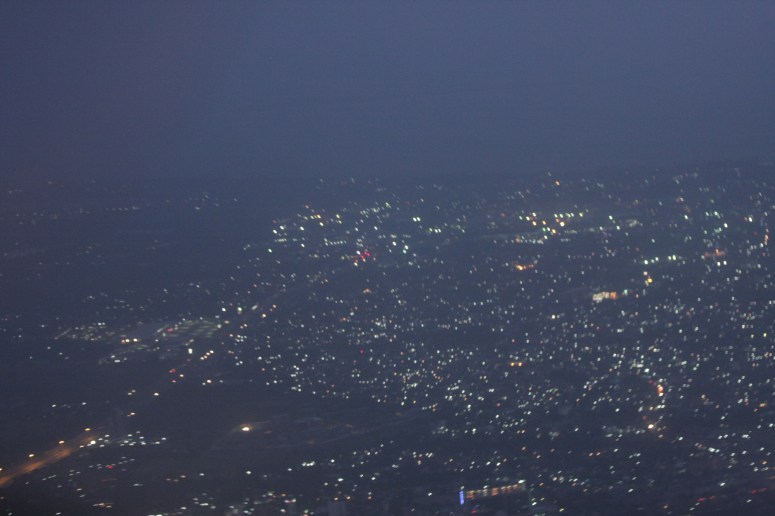
On the little propeller driven plane, we depart Dar for Kilimanjaro. En route we cross over the plains that make Tanzania a popular destination for safari tours and as we begin our descent to Kilimanjaro Airport, our Pilot calls out to the passengers to look out the windows on the right for a glimpse of Mt Kilimanjaro. My jaw drops to the floor and I look to my fellow hikers and we agree silently “What the f&^k are we doing here”. After the euphoria of seeing Mt Kilimanjaro for the first time in person, reality sets in and we quieten.
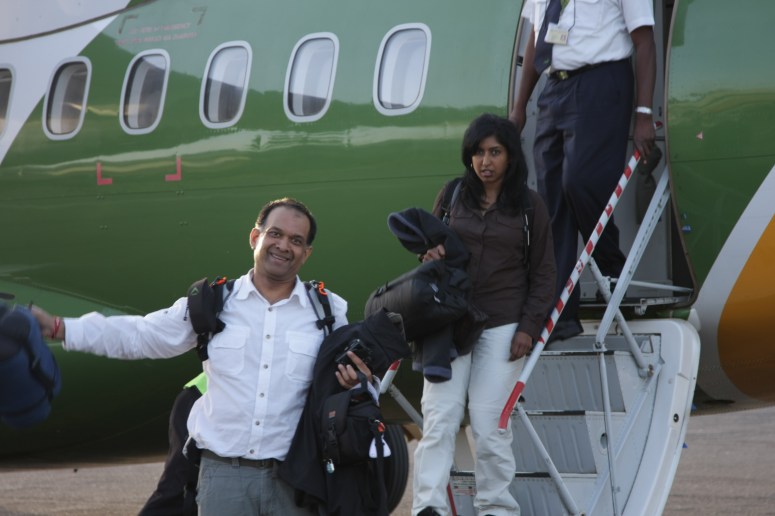
The trip from the airport to our hotel is low-key but we are now anxious because losing 1 day due to the flight delay, we are expected to get going today. There is no time to acclimatise to life in Moshi Town, our base for the trip.
Off to the Mountains with you lot …. NEXT
We are asked to take a quick shower, unpack and repack for the 7 days on the mountain and return to the hotel lobby for a briefing and breakfast…… Ahhhhh the pressure.
No time to haggle, we comply and are ready in our mountain best with shining new backpacks loaded with goodies. “It is too heavy”, says the lead guide Honest, “you will struggle. Please lighten the load and transfer items to your duffel bags for the porters to carry”. On Kilimanjaro, porters provided by the Kilimanjaro Nature Reserve authority are the “work horse” on the trek. They carry the loads from point to point daily as “Guests” walk only what they need for the day. It is on the Porters’ backs that us Trekkers are able to summit this mountain.
Cook, CampMaster, Guides, camps, utensils and other gadgets packed into the service vehicle we are asked to take our seats for the ride to the start point, Machame Gate.
See my post titled
Vanishing into Thin Air – The Volcano Above the Clouds
under the Mount Kilimanjaro menu for more details on the various trails


Machame Gate
The ride to Machame Gate from Moshi Town is an adventure on its own, especially when travelling in a 4×4 vehicle which seems not to have been serviced since it was purchased. The non-greased suspension squealing its way through the mountainous terrain pierces the silence in the vehicle. Our guides (Honest Matto and Elipokea Mosha) try to pick up our spirits; we respond and quieten again. We stop to take a few pictures of the landscape and surrounding village of Machame and this helps with the morale.
The vehicle engine starts to whine and groan; clearly we are in the foothills of Mt Kilimanjaro. There are a lot of local people walking towards the mountain. These, we are told, are freelance porters who are finding their way to the gate seeking work from Guests. The mountain is critical to the livelihood of those who live around it. It provides much wanted currency (especially US Dollars), which could mean the difference between food on the table for a month and going to bed on an empty stomach.
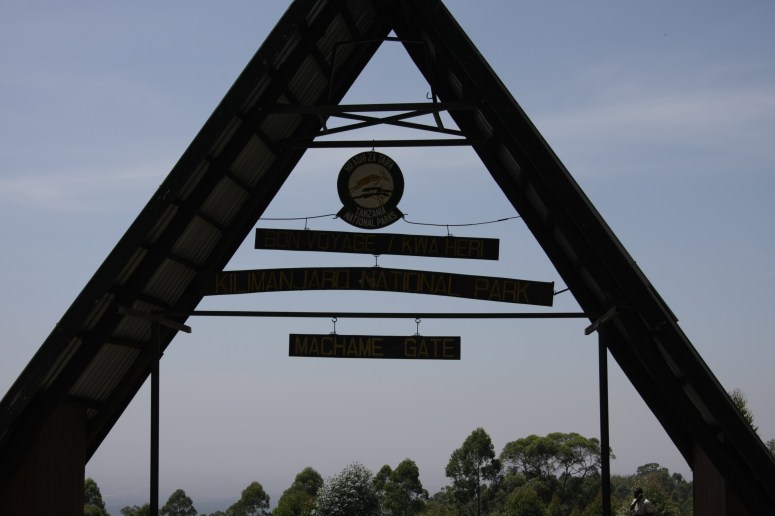
On reaching Machame Gate, our start on the Machame Route, we are greeted by a large structure under which we drive. There is welcome sign followed by Do’s and Don’ts and warnings about health issues and the fact that you are taking on a mountain. It is not a walk in the park, despite what many tour operators will tell you.
At the gate, our luggage, the camping equipment and all the gear being carried into the reserve is weighed.
Weighing of luggage is done by the Park Authorities as it determines how many Porters would be needed to carry the full load of the party. It is a bargaining point because the more porters the Park Authorities force on the team, the less each member of the support team takes home. One can sometimes wait for a while at this point before being cleared to go through the park gate.
We are given 8 porters to carry the load that our team will be needing on the route. That sorted, we are cleared to go through the gate and our hike to Machame Hut starts.
Day 1: Machame Gate to Machame Hut
We follow a 4×4 road to the point where we turn into the rain forest. The terrain moves from smooth road to a hiking trail and it goes uphill quickly. The rainforest is cool and the shrill of insects can be heard all around. Water trickles down rocks as it makes its way into the rivers and streams that the villages around the mountain rely on. Life seems idyllic at present, as the slope eases.
But as quickly as we entered the rainforest, we start to leave it behind. We pick up a ridge and walk out of the forest and the vegetation changes to scrubs and moorland as opposed to trees. The going is tough but we make progress towards camp. Our energy levels are quickly reducing and we can’t wait for camp. We hear voices around us and hope that it is coming from camp, but alas, these are porters who have left the gate later than us and are now picking up their pace and walk past us with their heavy loads. We are humbled by their prowess on these tracks with the loads that they carry.
Before long, we reach a clearing. The first sights of Mt Kibo come into view and a little further up the track its CAMP. It has been a tough first day but we are delighted. Our bodies have survived and we can look forward to a good meal and a well earned rest. Tomorrow is another day.


Day 2: Machame Hut to Shira Camp
Today, our hike is up a steep scramble of rocks to a plateau where we stop for lunch and then onto the Shira Plateau where we overnight.
It is short walk in distance but it takes us 8 hours to reach the Shira Plateau. From this vantage point, Mt Kilimanjaro’s 2(Mt Shira and Mt Kibo) of the 3 peaks can been seen. The other, Mt Mawenzi will come into view on day 5 only.
The Shira Plateau is a wind swept perch where Mt Shira once stood. It is now completely extinct and one can barely make out the remaining caldera of what was once a volcano that stood proud and high. We meet the team today and learn each other’s names. We are formally welcomed by the team and after dinner, retire to our tents for a well earned rest. Tomorrow is a long day as we start on our walk high, sleep low technique to get acclimatised to the increasing altitude.
Day 3 – Shira Plateau to Barranco Camp


Today is our first walk high and sleep low opportunity as the first 2 days was just up, up, up. Today we also meet up with hikers coming in from the routes that start in the western edge of the Reserve.
Our hike takes us out of the Shira Plateau towards the Mt Kibo plateau and we see immense rock falls and a feature called Lava Tower. This feature was created by lava flow when Kibo was active and it is a spectacular site. Lava Tower is our lunch spot on today’s hike. Lunch dispensed with, we continue our hike towards Barranco Camp. The Barranco Valley and Umbwe river was created when a large section of the western edge of Kibo’s crater, which was laden with glacial ice, gave way and cut the valley and today still feeds the river. There is a summit path here through the Western Breach but the Park Authorities do not promote it due to the ever present threat of rock and land slides due to a large amount of loose rock and ice.


It is a long walk today and I am glad to have the miles in the legs. Walking downhill is tough, tougher than going uphill. Toes jam against the boot and feet slide about inside the boot resulting in pain and blisters. Luckily, I do not suffer any blisters but my toes are sore. I can’t wait to get the boots off and free the toes.
We reach Barranco Camp later than we expected to as the downhills were tough. Entering the Barranco Valley, one cannot but notice the climb out of the valley; Barranco Wall is the result of that rock and ice that broke away from the Western Breach that cut its way through this valley. Hikers have named this obstacle the “Breakfast Wall” as it is the first obstacle on our path out of the valley after breakfast.
As night falls, the darkness and remoteness of our camp, allows the stars to come out in their glory. I’ve been looking at the heavens most of my life and I’ve never seen the sky filled with as many stars as I see tonight. I am awestruck.
There is a story of me and my super-bright torch at Barranco Camp. It is embarrassing as much as it is funny. If you care to hear it, remind me to share it when you see me. I am not committing that story to electronic pages.
Tomorrow is another long hike with 2 valleys to traverse, but tonight all I can think about is that Breakfast Wall. How does one traverse something like that?


Day 4 – Barranco Camp to Karanga Camp
Up early to catch the sun rising above the Kibo Plateau and it provides a wonderful opportunity to use the light effectively for a great photo.
Breakfast dispensed with, we make our way to the Wall across the Umbwe river, which is now a stream. The climb up the wall is surprisingly easier than I thought. We have a few scrambles and narrow paths but this quickly changes to a more easier slope and we make good progress up the wall. A hour and a half later, we are on top and again on the Kibo plateau. Excited about our accomplishment, we forget that we still have a scree slope to deal with and the Karanga Valley to traverse before we reach camp.
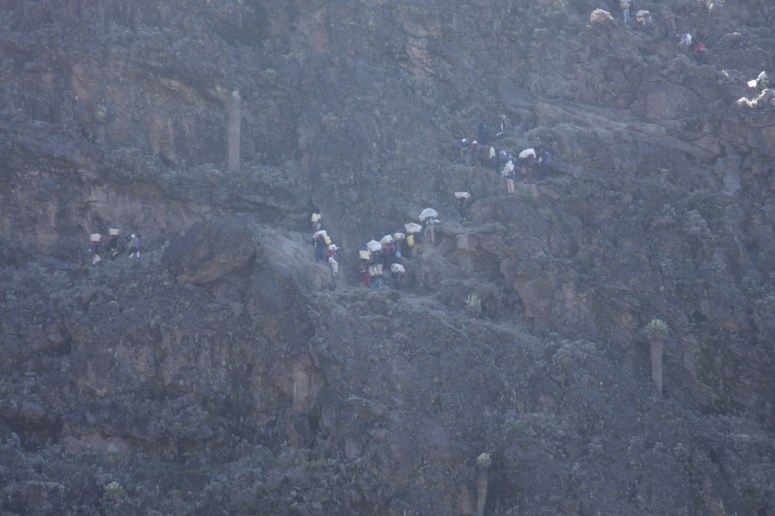
The scree slope is tough to walk in. It is a slope that is covered with pulverised ash (silica and other material) and it lays soft underfoot. Getting traction is difficult and this stuff cuts through the hiking pants and boots. A gaiter is a preferred option here. I’ll go further to say that it should not be an option. Should these grains of silica find their way into your boots, you can lacerate your socks and feet.
Luckily we do not spend too much time in the scree slope but it does give us a sense of what is to come on summit night. Be scared, be very scared.
Scree slope dispensed with we make our way towards Karanga Valley and Karanga Camp. Camp is on the other side of the valley and we have to descend to the valley floor and then make our way up the other side to camp. As we descend, our guides point out another rock feature. This time the rock has over time been shaped as a turtle, complete with it head sticking out of its shell. It is remarkable how closely it resembles a real turtle. We take pictures of this feature but the terrain around us is very precarious. We are standing on rock and there is a think layer of soil into which some plants and moss have sunk their roots. As we step on these, the soil gives way and we slide. Water trickles onto the rock making it even more dangerous. Our guides ask us to trust our boots. This is easier said than done but we trust the experience of our guides and make it down into the valley.
Climbing up is even tougher than the Barranco Wall. Karanga presents a steep valley wall to the hiker and the only way to get through this obstacle is to use the switch back method. Trying to walk in a straight line up this wall may result in broken achilles tendons or cramped calf muscles. Progress is thus slow and 45 minutes later, we emerge at the top.
Tomorrow is the final leg of our hike to the Barafu High Camp, from where we start our summit.


Day 5 – Karanga Camp to Barafu High Camp
Today is a short hike as we make our way to the Barafu High campo which will be our base for the summit attempt. We will reach Barafu in 4 hours but will need to recoup for our summit attempt which starts tonight.
Barafu High Camp nestles on a ridge that takes one up to the Reusch Crater rim at Stella Point. Being a ridge, there are no flat spots to pitch tents. Tents are pitched where ever space is found between rocks. We explore the surrounds and watch the clouds come up the valley and dissipate. It is cold here and the summit of Mt Kibo looks incredibly close, yet we know that it remains far to reach.


Days 5 & 6 – Barafu High Camp to Uhuru Peak (via Stella Point)
After a little rest and food, we do a final check for summit. We don our summit gear and we will be leaving in the night when it is at its coldest. The reason for this is that the scree that covers most of this route up is better walked on when it is frozen. The sheer effort of walking of loose scree may use up all the energy and limit a hikers chance of a successful summit.
At 22h00, we are woken, we take the last nourishments and make a final check for gear (for the ascent and descent). Temperatures range from -20 at night to +40 during the day, a swing of 60 deg. C. At 23h00 we set off for the summit. Honest and Elipokea discuss the summit attempt and agree to rope in the Cook, who is an experienced climber, to join the summit party. The Porters remain at Barafu High Camp while the Guests and Guides summit and return. Today we will be 6; 3 Guests and 3 Guides (including 1 Cook). I am paired with the Cook with Honest and Elipokea taking care of Chantal and Chandra respectively. They are concerned that we may split up and hence require that we each get paired with a “guide”.
Our head-torches only light up the path in front of us and we cannot see beyond a few metres. Not having a context of the area, we do not know what to expect. Our first hurdle is a large rocky outcrop that we have to scramble over. Suddenly we find ourselves on a plateau with what looks like another camp.
In my research, I did recognise that a camp exists in the crater. My inexperience showing, I thought that we had breached the crater rim and were in the crater. Where’s the fuss?
I checked in with the guides as to the camp that we were just passing by. They confirmed that this was just another camp set up for hikers who overnight in the Crater Camp for their descending journey and this was indeed not Crater Camp. The reality is that we had another 6 hours to the crater rim. Damn.
As soon as we clear the plateau we hit the scree slope. It starts easy but quickly becomes monotonous and the slope increases. The switch-backs make the climbing distance a lot longer than the straight line distance. It seems to go on forever. My nose is running and after multiple swipes at it with the glove, it seems like its an endless task. I stop wiping my nose and the fluid freezes. Now all I have to do is to break the icicle off every now and again. I am breathing through my mouth anyway so who needs an open nasal passage?
As we walk, I notice lights in the distance. These are the head-lights of the hikers in front of us and some of these are stars over the horizon. My confidence is shaken as we seem to be going backwards when compared with some of those lights up front. We set on a pace where we walk for 50 minutes and stop for 10. Counting steps lightens the effort, focusses the mind and breaks the monotony.
Before long, I notice a set of lights that seem not to be moving away from us but actually getting nearer. I inquire with our guides and they play a joke on us telling us that those lights are stars that are fixed in the sky. I don’t believe this and look at my watch for validation of the time that we’ve travelled for a sense of the distance that we’ve covered. I note that we’ve been walking for almost 6 hours, so we should be close to the crater rim now. Testing this theory with the guides, they relent and confirm that the fixed lights are actually lights that are fixed on the board marking the breach of the crater rim at Stella Point. I am filled with confidence with that news. We are almost at the top …… No, now we are on top.
Day 6 – Stella Point

We are elated with our triumph. Breaching the crater rim, the pressure on the calves and achilles eases. We stop for a cup of hot tea that the guides secretly carried in their packs. This is very welcome as the wind that blew across the slope has dropped the temperature to -20 deg C. The sun has just broken over the eastern sky and the view is spectacular….. but we dare not linger.
Our guides remind us not to dwell at this altitude because we may not take off again and we are not yet at the highest point on Kilimanjaro, Uhuru Peak. They point out that Uhuru Peak is around the corner and up the drag towards the final slope. It is but a mere 1-2 kilometres away but this takes us 2 hours to get to. Our pace at this altitude drops considerably and every step is now a conscious effort. I find myself ahead of my team mates and soon turn around and go back to them so that we may walk the last section together.
We see the glaciers from inside the rim; yes they are majestic but not anywhere close to what I expected. The rate of glacier melt is immense and I shed a tear or two for the scale of the damage. Global warming is eroding the glaciers and within 30-50 years, there will be none left. Man’s influence on the Earth is not confined to the lower levels; a mountain as high and as imposing as Mt Kilimanjaro is not immune to the acts of Man.
We reach Uhuru Peak and I note that that iconic wooden marker has been replaced by a metal signpost. The advertising is false. I don’t like it, I don’t like it, I don’t like it.
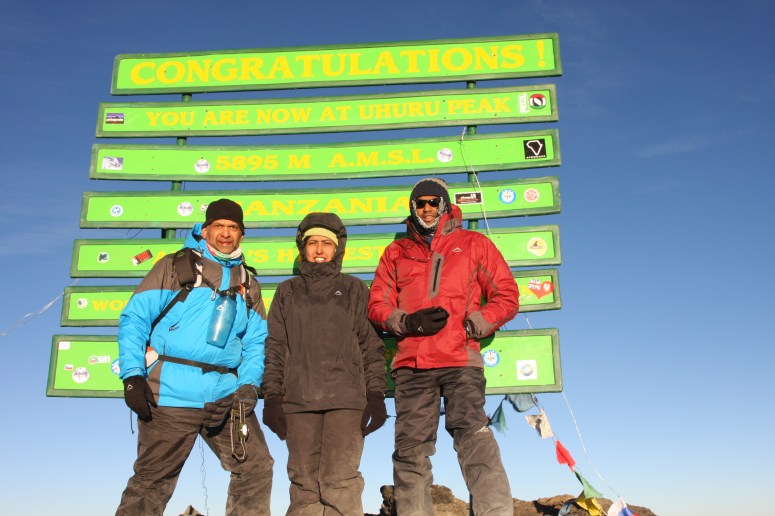
We take our pictures of the summit and the crater. I completely miss the cone and only notice when I review my photos that I caught pieces of it. It would have made a great picture if I could capture the entire cone and crater. Maybe, next time.


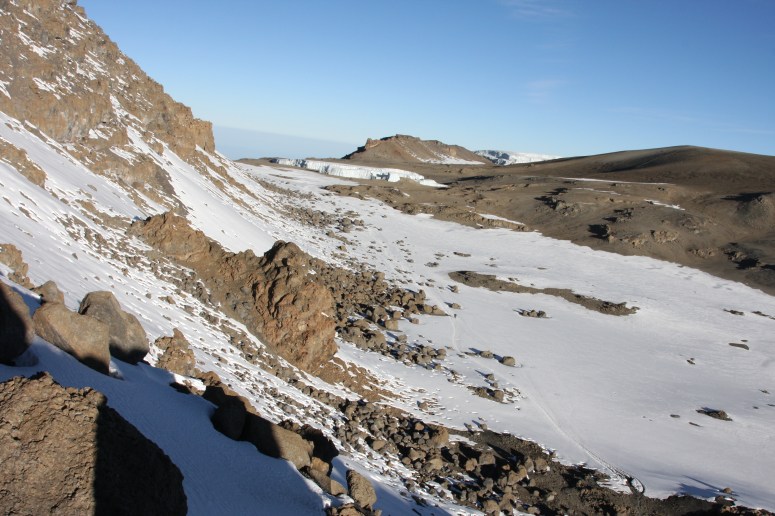
Our time runs out quickly and we are faced with some difficult choices. Chandra, who has been struggling with the lower pressure on the summit. Due to the limited pressure on the fluid in his eyes, his pupils and iris are impacted leading to blurry vision and he cannot descend on his own. The guides agree to rush him down to Barafu High Camp.
My Guide, the Cook, needs to rush back to Barafu High Camp to prepare lunch for us. He is my Guide, so I agree to descend with him. He is is mountain goat and me, well, just a goat. He skips downhill and here’s me trying to keep up with zero experience of how to handle the downhill. I soon learn that it is similar to skiing down a mountain, so I tuck in the knees and allow my weight to take me down, stretching out and speeding up whenever I slow down. We make good time on the descent and arrive at camp a mere 3.5 hours from leaving the crater rim. I am exhausted and slump down in my tent and sleep takes over.
Day 6 – Barafu High Camp to Mweka Camp
Chandra and Chantal are slower and arrive at camp around 1.5 hours later. Chandra is recovering as the increased air pressure at the lower altitude has reversed the effect on his pupils and iris. Honest takes no risk, he allows Chandra to rest a little and then off they go to the lower camp.
Chantal on the other hand starts to feel the effect of the downhill on her knees and she is in pain. Sometime later, we are summoned to pack and leave Barafu High Camp for the lower camp. Note that Chandra is on his way there some 2 hours or so ahead of us.
As we leave, Chantal’s knees start to flare up and the going is though and slow for her. Between Elipokea and me, we try to lighten her load by carrying her backpack. She is still struggling. There were instances where Chantal asked that we leave her on the path and that we come back for her the next day. This we could not accede to.
On the trip down, there are 4 things against you;
- The euphoria of summiting is now behind you;
- The energy spent on summiting leaves very little for the descent;
- Downhills are taxing on the body, especially when the technique of going downhill is not mastered; and
- The distance to the next camp is further relative to the camps on the ascent route. By way of comparison, we left Barafu High Camp which we reached on day 5 of our ascent and we need to descend to the equivalent of Machame Hut which we reached on day 1 of our ascent.
These are the conditions we found ourselves in and to boot, we had a friend in utter pain, anxious that she may not make it to camp tonight. We slowed to take many rest breaks so that we could give Chantal time to recover. She is a champion and despite the pain, steeled herself and walked towards camp. We arrived at camp around 19h00. It was getting dark and we were running the risk of descending in the dark. You don’t want to be in that situation.
We find our camp, settle Chantal in, get some dinner and shut down for the night. I’ve never earned a sleep like that sleep, that night.
Day 7 – Mweka Camp to Mweka Gate
We get up at a normal hour today. Camp is being dismantled as we mill around. Breakfast is taken and the Porters and Guides break into song. This is the last time we will be seeing the Porters sent by the Park Authorities. Our crew from the hotel will return to the hotel with us. We say our goodbyes to the Porters and hand their cash to Honest. The Porters final job is to deliver our gear to the waiting vehicles for our transfer back to the hotel. Honest will pay them their due once all the gear are accounted for.
With that done we depart for the Gate.
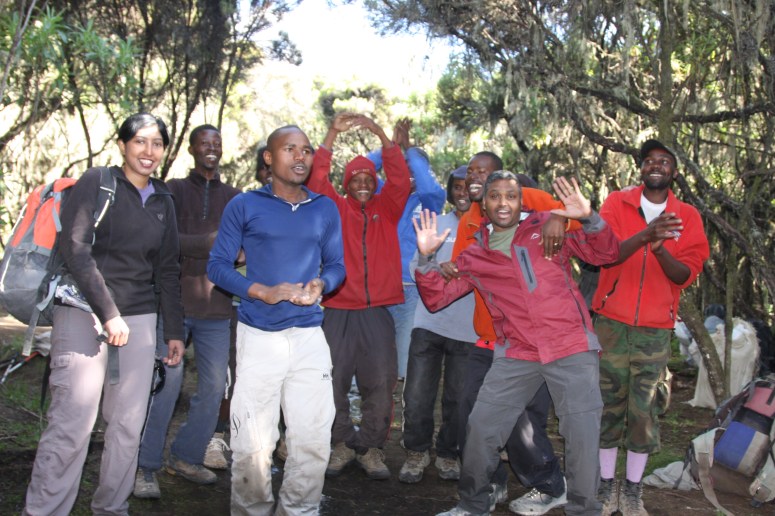
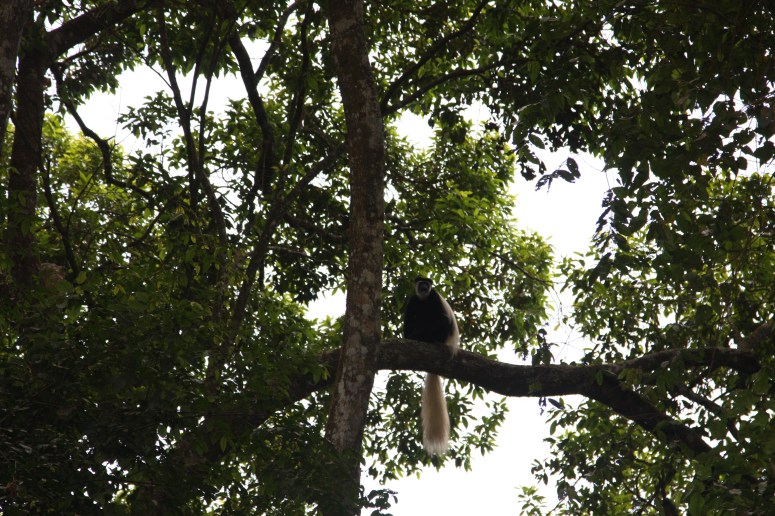
The going is good and we make good time. Just about to leave the park gate, we see, for the first time, the Colobus Monkey. We’ve walked the rainforest on the way up and down and not seen a single primate and here just before the gate, a troop of them milling around in the trees.
We exit the Gate and into the office to sign-in and receive our certificates. Honest hangs onto these for the official ceremony back at the hotel tonight.
Back at the hotel, we wash off the grime of the last 7 days, get into a better smelling outfits and head back to the hotel bar. After the awards ceremony, we pay the hotel staff who accompanied us on the mountain (Guides, Cooks, Camp Master etc) and retire for the night. Tonight we will sleep on a proper bed.
Day 8 – Kilimanjaro to Johannesburg (via Dar-es-Salaam)
Off to Kilimanjaro Airport for our return trip to Johannesburg. We say our goodbyes to the hotel staff and our guides, who return to accompany us for a trip around Moshi Town.
Our flight from Kilimanjaro Airport to Dar-es-Salaam is a non-event. We depart Dar-es-Salaam a little later than scheduled and as soon as we are over the open ocean, the plans starts to shake violently and the Captain announces that we are losing cabin pressure, so he had to descend and we will be returning to Dar-es-Salaam. The flight back to Dar is scary. Passengers talk bravely whilst gripping the armrests and others just show their naked fear. After what seems like an eternity, we enter Dar-es-Salaam airspace and start the descent for Dar airport. We land to a thunderous applause from the passengers. We are just happy to be alive and applauding seemed to the right thing to do. I think it was just spontaneous reaction to getting out alive from a very scary situation.
Our layover in Dar is exhausting. The airline insists on fixing the plane and putting it back into service. We wait a few hours and it is in the early hours of the next day that we finally depart for Johannesburg. This time the plane performs well and we are back on home soil better for the experience of having summitted the highest point on the African continent.
 Mountain Guru