
Disclaimer
This blog neither encourages nor does it recommend the use of medication on the mountain. The author cannot be held responsible for any misinterpretations by the reader which results in self-medicating based on this blog.
Please consult your physician for any and all medications that you may want to consume on the mountain. Some medications may interfere with others and others may block critical symptoms that may prevent the guides, expedition leaders and Doctor from administering critical care during the hike.
There are many different articles on how to acclimatise for low oxygen environments. This article attempts to explain the physical reason for low oxygen environments and the impact this has on our physiology.
To begin lets consider the facts of low oxygen environments.
Composition of the Atmosphere
The atmosphere of Earth is the layer of gases, commonly known as air, that surrounds the planet and is held together by Earth’s gravity. The atmosphere protects the Earth from harmful ultraviolet solar radiation by absorbing them and creates the pressure that allows for liquid water to exist on the surface of the Earth.
The composition of air is 78.09% Nitrogen, 20.95% Oxygen, 0.93% Argon, 0.04% Carbon Dioxide and other trace gases.
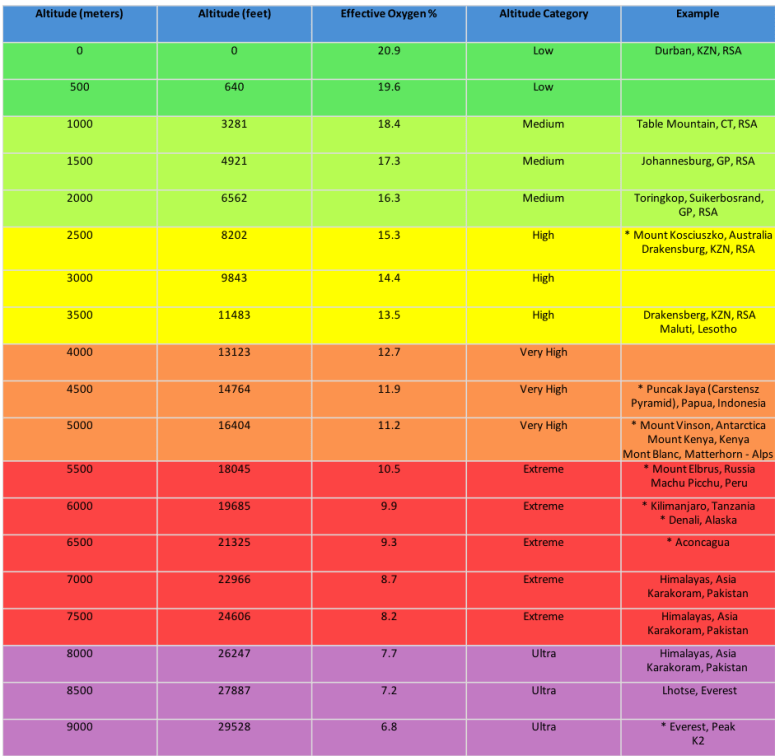
The atmosphere has a mass of 5.25 x 10 power 18 kilograms. Three quarters of this mass is within the first 11 kilometres from the surface. The atmosphere becomes thinner with increasing altitude and there is no definite boundary between the atmosphere and outer space. At sea level, the weight of the entire atmosphere forces molecules of air to stick closer together, hence water in liquid form exists on the surface of the Earth. So it stands to reason then that as the altitude increases, the reduced atmosphere, which is less heavy, exerts less force on the molecules of air allowing them to disperse further away from each other. It is this force on the air molecules that make the effective percentage of oxygen decrease as the altitude increases.
The chart below shows the amount of effective oxygen percentage at the various altitudes, with landmark references for your orientation.
The Human Respiratory Process
The blood circulatory system moves blood around the body with the heart playing the role of the pump; the lungs the role of the oxygen/carbon exchanger, the arteries the role of the vessels carrying oxygen-rich blood to the cells and the veins which return deoxygenated blood back to the heart to restart the process.
Blood oxygen levels are a measure of oxygen-saturated haemoglobin relative to total haemoglobin (haemoglobin being the red blood cells that carry oxygen). This is known as the SpO2 (peripheral oxygen saturation). Normal SpO2 levels, measured at accepted mean sea level (0 amsl), are between 96% – 99% and should be over 94%. At 1,600m amsl, oxygen saturation should be over 92%. Anything below these numbers are considered low and could lead to hypoxia.
Impact of low oxygen levels at higher altitude on the Human body
In an environment of low oxygen, hypoxemia is the first sign of oxygen depletion. Hypoxemia, which is the low saturation of oxygen in the blood, progresses to hypoxia, which is the starvation of oxygen in the cells if a reversal of hypoxemia is not managed. Hypoxia eventually leads to the cells ceasing to function and then to the death of the cell.
When the body detects that it is going through a low oxygen saturation situation, it will tend to respond and thus acclimatise. The difficult part is in the detection.
A 2018 study conducted by Tesla on potential astronauts for their Mars colonisation programme, a hypoxemia/hypoxia situation was tested and it was found that not everybody has the ability to detect a falling blood oxygen level. So much so that some astronauts did not recognise the fall in oxygen, which resulted in an aborted test where oxygen levels were so severe that oxygen had to be reintroduced to the subject.
The reason for this is that the symptoms of hypoxemia/hypoxia are slow to manifest and, for us Mountaineers, we have the added complexity of these symptoms being masked with that of a cold environment and by the effort being expended in hiking or climbing. The symptoms are:
- Headaches
- Tingling fingers and toes
- Cold hands and feet
- Nausea
- Vomiting
- Double vision
In a continued reduced oxygen environment, the brain detects the acidity/alkalinity of the blood and responds when the blood is determined to be acidic (< pH 7). The heart is summoned to beat faster, thus increasing the circulation through the lungs; the blood volume is increased in an attempt to increase the number of haemoglobin cells and the lungs are summoned to breathe faster to increase the air in-take. These are the first symptoms of mild hypoxemia.
If, however, the brain continues to detect falling oxygen levels, severe to chronic hypoxemia will occur. Blood supply to the extremities will be reduced and finally, cut-off, if the situation is not reversed. This is the primitive (primal) brain taking over control in an attempt to keep the critical organs operating just to survive. Pulmonary and/or Cerebral edemas can result from continued exposure to low oxygen levels.
How to improve oxygen-levels in the blood
- Eat more iron-rich foods – leafy green foods are the ones to target
- Stop smoking
- Increase the consumption of antioxidants, especially glutathione
- Take a 1/4 teaspoon baking soda dissolved in a glass of filtered water daily until the pH of your saliva is around 7.4 (pH 1-14 with 7 = Neutral; >7 = Alkaline and <7 = Acidic)
- Take Ubiquinone (CoQ10) which aids mitochondria during energy production
- Increase vitamin B12 and folate in-take
- Take drops of chlorophyll (eg. BarleyMax)
- Increase in-take of vitamin A
- Massage to increase blood circulation
- Decrease cholesterol levels if it is above normal levels
The Key Question – to Diamox or not to Diamox
Quite simply, this is best answered by your Physician. I recommend a full body examination with bloods so that you and your Doctor are better informed and can home in on the correct course of action.
But let me take this opportunity to inform you of how Acetazolamide (Trade Name: Diamox) works.
Diamox being a diuretic assists with the increased removal of water and salts through urine. In the treatment of mountain sickness Diamox increases the excretion of bicarbonate (which is formed after carbonic acid donates a proton during a chemical reaction) through the urine. By increasing the amount of bicarbonate in the urine, the blood becomes more acidic. The body equates acidity level to the concentration of carbon-dioxide hence when bicarbonate is excreted and the body is tricked into believing that the carbon-dioxide levels are increasing; the body responds with deeper and faster breathing in an attempt to rid itself of this fantom carbon-dioxide thus flushing the body with oxygen.
Diamox is not a cure for mountain sickness but speeds up the acclimatisation process which relieves the symptoms of high altitude.
Dosage
1,000mg of Diamox should be consumed 1 day prior to travel to high altitude and continued for the first 2 days at altitude. The user must consume lots of water and must urinate frequently.
Disclaimer
This blog neither encourages nor does it recommend the use of medication on the mountain. The author cannot be held responsible for any misinterpretations by the reader which results in self-medicating based on this blog.
Please consult your physician for any and all medications that you may want to consume on the mountain. Some medications may interfere with others and others may block critical symptoms that may prevent the guides, expedition leaders and Doctor from administering critical care during the hike.
 Mountain Guru